Enga Province, Papua New Guinea
Enga Origin Traditions
An archive of oral history
To help guide your journey, we’ve organized the website into regional chapters. Each one introduces you to the people of that area and points you toward the origin traditions of its major tribes.
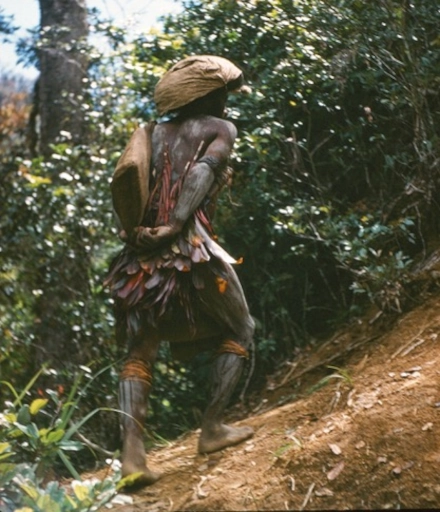
Traveler. Photo by Rev. Harley Kopitsky, Kundis.
Table of Contents
Traveler. Photo by Rev. Harley Kopitsky, Kundis.
CHAPTER 1: INTRODUCTION TO WEBSITE
CHAPTER 2: ENGA HISTORICAL TRADITIONS
CHAPTER 3: PRE-COLONIAL HISTORY
CENTRAL REGION TRIBES
Chapter One
Introduction to the Take Ande Website
on Enga Tribal Origin Traditions
The cultural wealth of Enga lies elsewhere—in the wide variety of oral traditions that were passed down in men’s houses for ten or more generations: sung tales, myths, songs, poetry, and atome pii, the more factual historical traditions of tribes and clans. The work of Roderic Lacey had shown that these historical narratives were key to opening the door to Enga history, as well as providing narratives to unify clans and tribes. However, they had not been systematically collected.
At the end of 1985, we set out to record the “origin traditions,” or charter narratives, for Enga tribes and their genealogies, which lay out tribal structure and identity. We began by visiting all tribes in the province to collect their origin traditions, genealogies, and legends of tribal dispersals. We felt we could accomplish this within a year or two. However, as we crossed ridge after ridge, we found far more than expected—historical traditions on wars and migrations, religious cults, bachelors’ cults, ceremonial wars, and agricultural innovations. Our goals expanded, and some 40 years later after many ups and downs, we are still learning. There is always more to the journey.
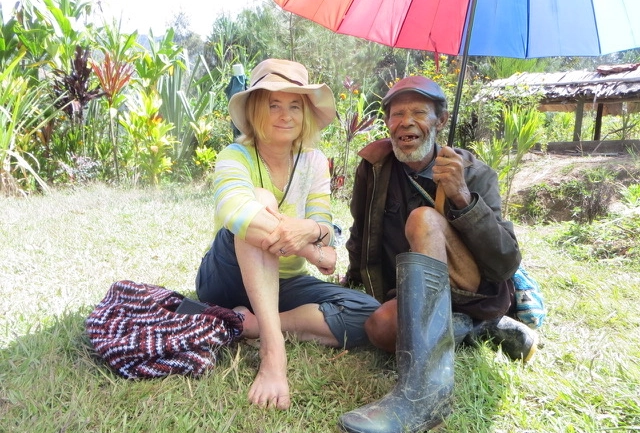
Polly Wiessner listening to traditions about Mt. Tongopipi with the late Pastor Alo Pitu near Mulitaka
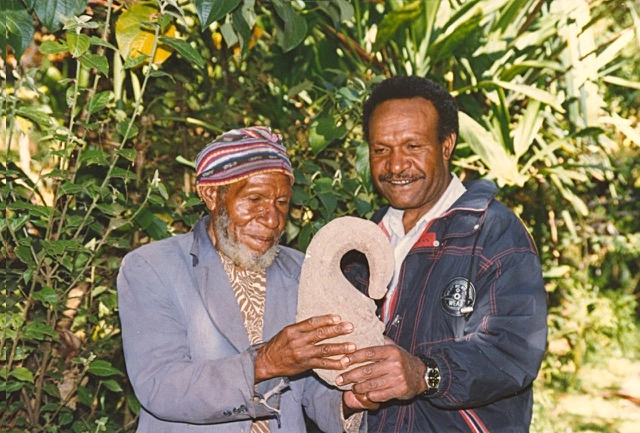
Akii Tumu and Kyakas Sapu of Lupamanda (Wabag) discussing the Ambum stone at the Taake Anda in Wabag.
Alome Kyakas joined us in 1986 and collected stories of women’s lives, while Pesone Jarwe Munini researched ritual traditions. Nitze Pupu assisted us from the beginning with outstanding translations of most of our recordings and by collecting an outstanding history of his own Yakane tribe. Many other Engans have helped us along the way, until we had collected the atome pii for 109 tribes of Enga.
After ten years of research, we compiled much of the information we had collected into the volume Historical Vines, published in 1998, that documented the extraordinary developments in Enga society over the past 350 years prior to contact with Europeans. In 2009, we opened the Enga Take Anda Museum and research centre to replace the former Enga Cultural Centre, returning the results of our research—and that of others—to the people. In 2016, we launched the Enga Cultural Education Program to transmit knowledge of Enga cultural heritage to K6–12 students in primary and secondary schools.
However, we never published the origin traditions and genealogies collected for most tribes of Enga. We had felt it was questionable to put this information into print because we knew it was far from complete — we had very rich material for some tribes and very sparse material for others. Was this because some tribes had not maintained their origin traditions, or because we had not encountered the most knowledgeable elders?
“As we crossed ridge after ridge, we found far more than expected — historical traditions on wars and migrations, religious cults, ceremonial wars, and agricultural innovations.”
We have now decided to publish this material on a website so that the information we do have on individual tribal histories is available to the people of Enga. This information, though incomplete, is particularly valuable because we were privileged to speak with elders who grew up in men’s houses before or during the time that the Australian Administration and missions were established in Enga. Formerly, historical narratives were told in men’s houses, so if somebody altered them or related them incorrectly, others present could correct them. Such cultural transmission is no longer practiced today. Obtaining reliable information on the pre-colonial histories is ever more difficult.
Regretfully, there were areas that were too remote to cover at the time of our research. These include the northern regions around Yengis, Maramuni, Lyemi and the region southwest of the Wage River.
In addition to nine dialect groups of Enga language speakers, the province has five other linguistic groups: Ipili, Hewa, Nete, Lembena and Wapi (Map 1). We were unable to conduct research on these groups because of linguistic and geographical barriers. Important research on pre-colonial oral and historical traditions remains to be done in all of these groups.
Map 1. Linguistic and dialect groups in Enga Province
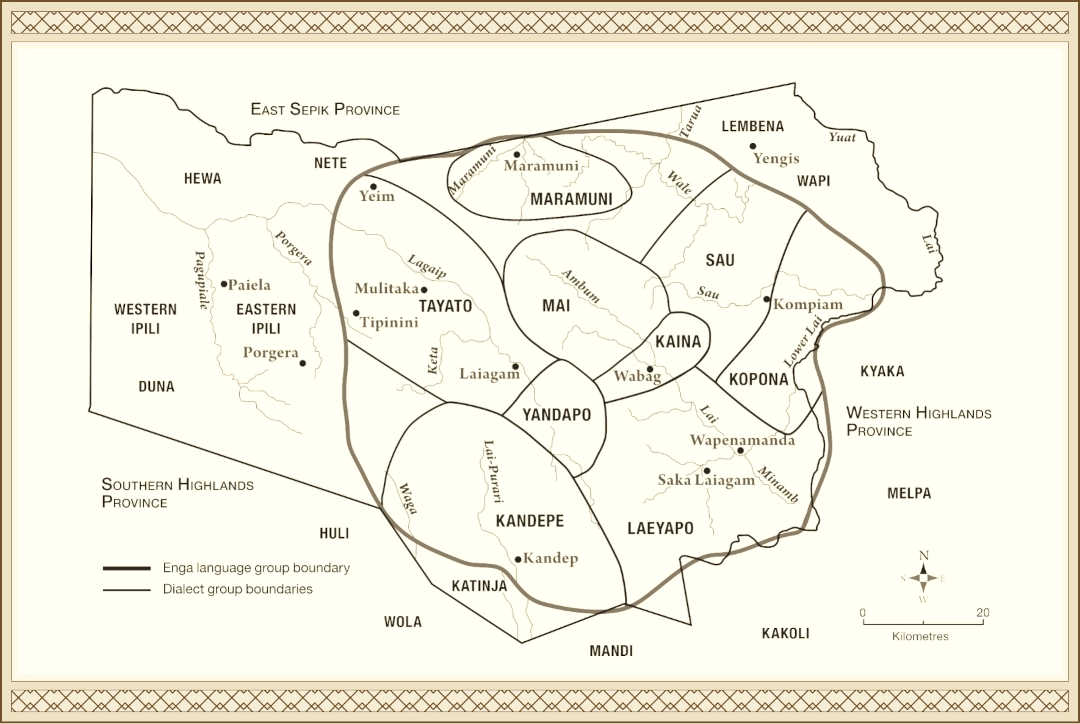
Over the years, we spoke with as many elders from each tribe as possible who were identified as men of knowledge. However, it should be clear that the historical traditions presented here cannot be taken as fact nor used for matters such as land claims. Polly Wiessner compiled all the information that we collected from different elders for each tribe into the tribal histories presented here. It was a challenging undertaking; she is responsible for any errors.
Our work in the 1980s and 1990s recorded only a portion of Enga tribal histories based on what we were told by the elders whom we encountered at the time. We have placed this material on this website that we hope will become an ongoing, interactive project. Engans who are knowledgeable about their own tribal histories are invited to bring additional oral traditions to the Enga Taake Anda. This information can then be added to the website as supplementary material, allowing the record of Enga tribal histories to grow over time.
Those Who Helped Us
Since we conducted this work, we have engaged in many more projects including the building of the Enga Take Anda and launching of the Cultural Education Programme. There are many more to thank but here we will restrict our thanks for this website to those who assisted between 1986 and 1996 when the material for this website was collected.
First and foremost, we would like to extend our gratitude to the hundreds of Enga who generously gave us their time and knowledge. We cannot name all of them. Very special thanks go to a few who became our teachers in oral history, devoting days of their time to help us understand: Leme Poul of Kaekini, Ambone Mati of Nemani, Yopo Yakene of Kamaniwane, Kopio and Kambao Lambu of Timali, Kyakas Sapu of Lanekepa, Saiyo Tondea of Sakate, Alo Peter of Kelyanyo, Tindiwi Loape of Yomondaka, Pakea Yakani of Yakumani, and Yakapus Mioko of Kamaniwane..
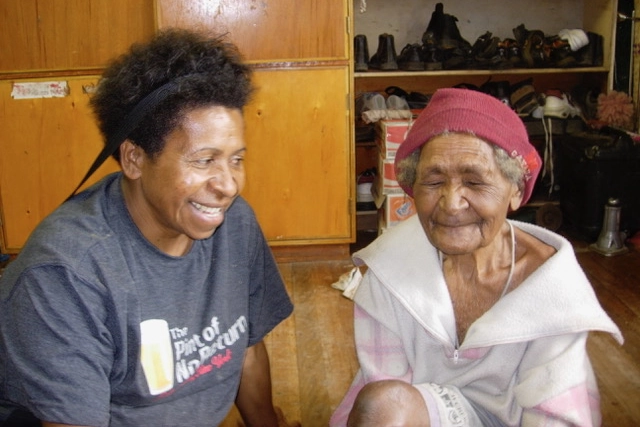
Alome Kyakas of Wakumale interviewing xxxxx (must find her name)
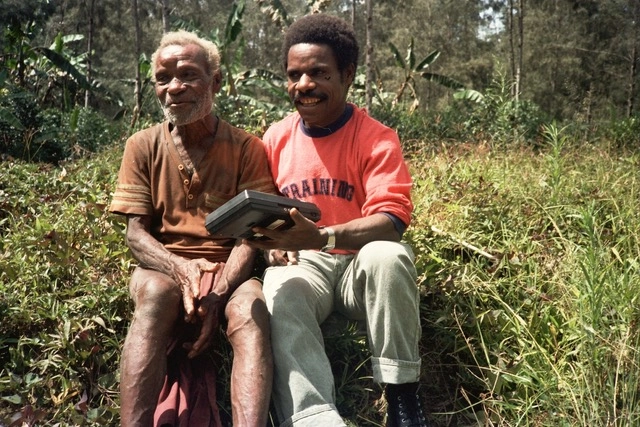
Pesone Jarwe Munini interviewing Yopo Yakena of Kaiap, Ambum-Lai ridge
We were assisted in our data collection by many literate Enga: David Hamal, Paul Steward, and Sakias Tamao of Kandep, Thomas Waip of Laiagam, Yoan Lapi and Peter Thomas of Mulitaka, Joseph Lakani of Par, James Mongola of Tari, Maria Kimala of Irelya, Robert Pyaso of Wabag, and Danny Kili Nembo of Awalemanda. Others working at or in association with the Cultural Centre contributed significantly to research and translation: Alome Kyakas, Pesone Munini, Meck Kepai, Lelyame Yoane, Kuna Masili, and Andy Utuwai. For their assistance, we are most grateful. The late Lazarus Endikio accompanied us on many trips, providing help or humor on all occasions.
Particular thanks are due to Fr. Philip Gibbs, Chris Ballard, and Rod Lacey for sustained interest during our research and for reading and commenting on parts of our manuscript as it developed. Fr. Doug Young gave us numerous insights from his participant studies and programs in conflict resolution. Fritz Robinson generously provided us with his notes and thoughts from his personal experiences in the Sangai. Many helped us with advice, problems and practicalities including Leo Ango, Paul Brennan, Paul and Ruth Wohlt, David and Lois Birner, Graham and Gelma Taylor, Peter and Josie Mommers, Alois Hemetsberger, and Elias Posi. During July-August 1995, Sr. Katherine, Fr. Tony Kröl, Fr. Doug Young, and Sr. Henrilena Par Catholic mission kindly hosted Polly with good food, lodging, and conversation. Gelma and Graham Taylor, and Frank Faulkner repeatedly welcomed us with warm hospitality.
It takes effort to go through old photos, select the best, and donate them in order to transmit information from the past Dr. Paul Brennan, Rev. Otto Hintze, Fr. Gerard Bus, Drs. Ralph and Sue Bulmer, Drs. Paul and Ruth Wohlt, Rev. Harley Kopitsky, Don Jeffers, Dr. Fritz Robinson, Dr. Mervyn Meggitt, Lee Meyer, Herb Schaan, Rev. Ian Walsh, Rev. Gary Teske, and Rev. Ian Grant generously provided invaluable images.
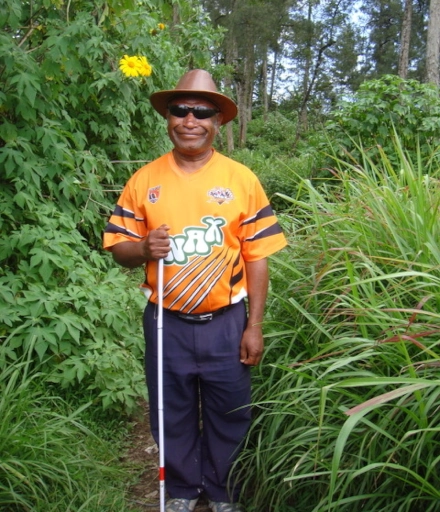
In the 1990s when we returned with additional questions, several Enga asked, “Haven’t you two been at this for an awfully long time, about ten years?” uncertain whether to wonder at our diligence or despair at our dull pace. Those who supported us over all these years must have felt the same way. This project began with minimal resources but gained funding as it grew. For the first three years we worked using our own resources and Polly’s private vehicle. The Department of Enga paid the salaries of Akii Tumu, Alome Kyakas, and Pesone Munini throughout the course of our work. It might be noted here that the Enga Provincial Government is one of the few in Papua New Guinea that supports an active cultural program on a long-term basis. From 1988-1995 the Forschungsstelle für Humanethologie in the Max Planck Society provided Polly Wiessner with an honorarium to work up the material and generously funded four trips for Akii to come to Germany to work up our material.
Over the years we received encouragement and assistance from many people in the Department of Enga, Enga Provincial Government or Enga Councils: Sir Peter Ipatas, Kundapen Talyaga, Mark Yappao, Tao Liua, Danley Tindiwi, Philip and Anguu Kyakala, Luke and Regina Kembol, Diri Kobla, Rance Mimi, Nah Tao, Anderson Aipiti, Henry Kyakas, Patricia Rimbao, Daniel Kumbon, Margaret and Pato Potane, Michael Mangala, Don Archibald, Albert MacSaen, Jeffrey Balakau, and Anson Isingi.