
KOMPIAM REGION
Kompiam Overview
A brief background on Kompiam
Kompiam, Papua New Guinea
CLANS AND TRIBES
Aiamane · Inapini · Ingi & Nenge · Lakani & Waitini · Lyongeni & Yangupini · Pumane & Aiyele · Sene & Yokasa · Tinilapini & Pumalini
GEOGRAPHY
Rugged mountain terrain · Steep slopes
Altitude: 1,400m – 2,300 m
Chapter FIVE
Kompiam, the "Warm Place"
In the northeast portion of Enga Province lies the Kompiam District. It received its current name when the first patrol post was established at what is Kompiam station today. The name Kompiam came from the Enga word kompona for a warm place due to its low altitude. The Enga in other parts of the province called those living in the Kompiam District Saune after the Sau River. Because Kompiam lies outside of the central valleys of Enga province and was populated by Enga clans later than other parts of the province, these incoming groups had to adjust to their new environment at lower altitudes.
Due to the fragmentation of clans with their migration to the Kompiam district, oral traditions have not been remembered, as well as they have been in the central valleys of Enga. Travel was difficult and involved crossing seemingly endless series of steep ridges and valleys with limited road access to reach most areas. As a result, the historical traditions which we have collected for Kompiam are often fragmented or shallow compared to those of more central tribes in the province.

PLACE HOLDER IMAGE EG. migration map
In the earliest historical traditions, it appears that there were only two Enga tribes in the Kompiam District who had migrated from the Ambum Valley into the Sau Valley: Waitini and Lakani. Much of the district was settled by people from other language groups. North of Laialama on the Wali River was the Yalipa tribe of the Lembena language group. As Enga speakers migrated north, the Yalipa moved further to the northwest. The Bulai, who speak both Enga and Lembena, claim to have been previously settled in the Tiogao valley between Pakalilyama and Yengisa. They appear to have moved further to the north with the arrival of the Sene-Yokasa Sinini clan from the Wabag area (Kompiam Patrol report Kom 2-58-8, p. 6).
Wapi speakers, who only numbered 1000 in the 1970s (Brennan, 1982), lived further to the west in the past and appeared to have been pushed to their current location by the eastward movement of Enga clans from the Ambum Valley. We did not obtain any precise information for past locations of Wapi groups, but in Kalipa Tipa’s account from Lakani and Waitini history he states that, “When the enemy clans from Wapi, Muudmuda and Sulungu who lived to the east came to Laialama to attack Lakani, then Waitini would help Lakani and when they came to attack Waitini, Lakani would help defend.” It is also mentioned in Kompiam Patrol Report 2-58-59 that a Lakani group crossed the Sau-Wapi divide and completely wiped out an unknown Wapi clan to take their land.
PLACE HOLDER IMAGE EG. migration map
PLACE HOLDER IMAGE EG. migration map
We collected two accounts of first contact between Kompiam inhabitants and migrating Enga tribes. The first comes from the Nenge tribe which was formally settled at Wapomanda, some 5 km north of Kompiam station. It is not known from which linguistic group Nenge belonged at the time, but they were said to have encountered a man from the Malipini Wailuni clan who taught him to make fire and later exchanged wealth with him. With the eastward migration of Enga clans from the Ambum Valley, Nenge clans settled in the Labalama-Lurisau areas and became assimilated into Enga culture.
The clans of Putini, Kunjaini and Matalini were at Labalama when Nenge moved into the area. It is not known which language these three groups originally spoke, but after contact with Enga clans, they adopted the Enga language. The following is a story of their lifestyle and fate:
“Before the people of the Putini, Kunjaini and Matalini clans lived at Labalama. At that time, they did not have stone axes or tools of any kind. They did not use fire for cooking, and they did not plant food crops such as taro and yams like people do today. They were hunters and gatherers. They hunted cassowaries, wild pigs, possums and snakes. They ate these raw. They went about like frogs and picked up nuts and cracked them with stones. I have gathered some of the rocks that they used for cracking nuts, namely, mortars and pestles.
Those were their living conditions until one day a man from the Malipini Wailuni tribe came here and taught them how to make fire using frictions sticks. They did not know about the advantages of fire, so he taught them how to cook food. They found that cooked food tasted good and so asked the Malipini to teach them to make fire, which he did. He also gave them stone axes and showed them how to cut down trees to clear the forest. It is also said that he taught them to wear clothing.
All of these things greatly improved the lifestyle of these people, but later there came a time when they suffered severely from an epidemic. The epidemic was not one of skin disease or headache, but one of acute dysentery from which many people died, both children and adults. Only those who had married out into other clans survived. In the aftermath of the epidemic, there was plenty of land left empty by those who had died out and the children of those who had married into other clans came back to live on this land. One of these was a boy named Lyingi who came with his parents. Lyingi grew up and had a son named Ipatana and Ipatana was my grandfather. My grandfather gave birth to my father, Lalyo and Lalyo gave birth to me.”
(Councilor Laima Lalyo, Ingi tribe, Labalama)
According to Councilor Laima’s calculation, the epidemic occurred some generations ago, around 1850. It is also mentioned in the histories of other tribes, even those in the Wapenamanda area, so it must have been widespread. The example of the Putini, Kunjaini and Matalini tribes is an interesting one in view of the many small groups that live in the northern and eastern parts of the Kompiam district today. It is very unlikely that these groups did not know how to make fire, but rather that this is a way of describing people who were largely hunter-gatherers and had different apparel. There is no known human society that does not know how to make fire.
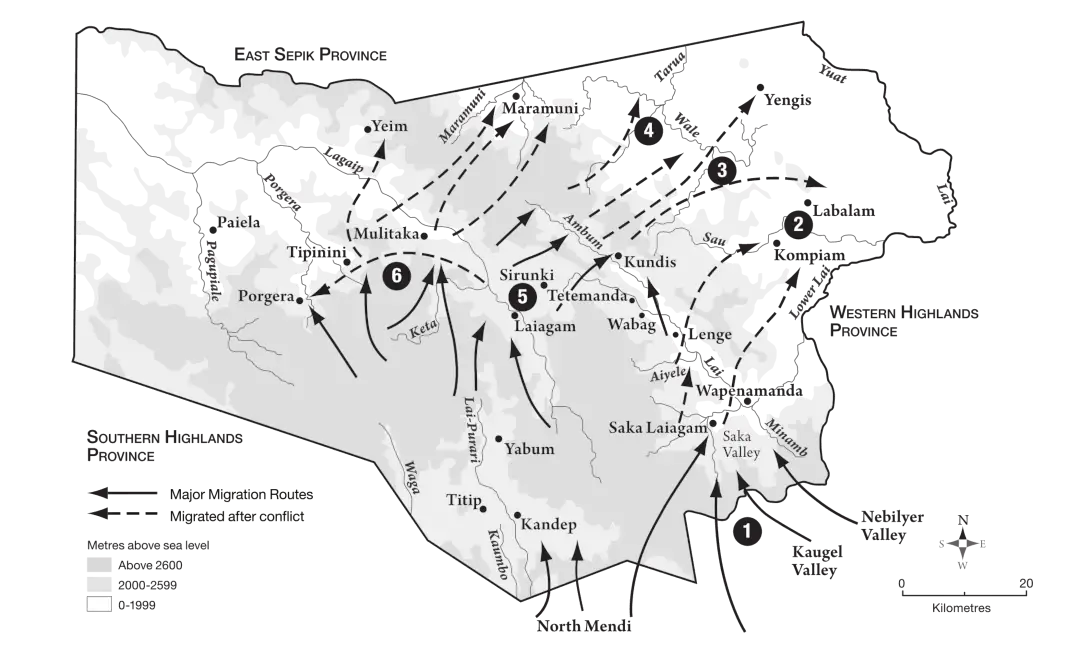
Major migrations after arrival of Sweet Potato
Migrations from the West
The peopling of the Kompiam area by Enga tribes occurred within the span of historical traditions in described two or three major waves of migration: one from the Ambum Valley what formed the Sau dialect group and the other two from the Tsaka Valley and Lai Valley that together formed the Kopona dialect group. The wave of migrations from the west took place about seven generations ago when the largest tribes of Lyaini and Sakalini together with Yakani and Yanaitini drove the clans of Pumane-Aiele and Sene-Yokasa (also called Kungu Tyaka) out of the Ambum Valley into the western Kompiam area. These were some of the largest wars documented in Enga historical traditions, resulting in the complete emptying and resettlement of the Ambum Valley by the victors.
Although the reasons given for these battles are trivial, most elders agree that the underlying motivation for these major wars was the acquisition of land in the fertile Ambum valley. The clans from Pumane and Aiele remained largely in the western part of the Kompiam District while clans from Sene-Yokasa spread out over the entire area north of the Sau River, driving out inhabitants from other linguistic groups. Later, groups that migrated to Kompiam from the Ambum Valley flourished and put themselves back on the map of trade and exchange through the Great Ceremonial Wars (see Chapter 2).
The wars in the Tsaka occurred around the same time or just before those in the Ambum (Ca. 1850). The entire Aiamane tribe was driven out of the Tsaka after a quarrel with it’s brother tribe, Ulidane, over firewood. The underlying reason is unknown. First, they fled to the mid-Lai Valley where Ulidane and Sikini clans in a joint effort chased them on to Kompiam. Around the same time Inipini also left the Tsaka for Kompiam after a quarrel with their brother Waimini clans. They settled southeast of Kompiam station. Whether Aiamane left all at once or in several waves of migration is not remembered.
After Aiamane’s departure from the Tsaka Valley, conflict broke out in the Pina/Akoma area. All Lyongeni clans left for Kompiam and clans from Sikini and Kandawalini took over their land. Lyongeni was followed by clans from its neighbors Tinilapini and Pumalini. Part of Tinilapini remains in the Lai Valley today, and the rest is settled in Kompiam. After moving to the Kompiam area, all clans from the Ambum, Tsaka, and Lai valleys expanded to cover most of the district and thrived. Let us now turn to their individual tribal histories.
KOMPIAM IMAGE ARCHIVE
Photographs from the Past
PLACE HOLDER IMAGE EG. migration map
The full archive of photographs are placed on a separate page to allow readers in Enga to choose whether to download them. Loading the entire page will use approximately 2 MB of data, with each image averaging 150 KB.
KOMPIAM REGION
KOMPIAM ORIGIN TRADITIONS
an ongoing project
If you know your tribe’s history,
help us record it correctly.
Because this material lives on a website that can be edited, Engans who are knowledgeable about their own tribal histories can offer corrections and additions through the Enga Take Anda.