Fact or Fiction
The structure of atome pii
PLACE HOLDER IMAGE
Chapter Two
The Structure of Genealogies
Deep History and the Limits of Origin Myths
Enga province has been inhabited for at least 13,000 years as evidenced from archaeological excavations at Yuku Cave in the Baiyer area and Kutepa rockshelter at Tipinini. Origin myths or narratives in the founding generations of genealogies thus do not explain tribal beginnings. They are charter myths or stories that validate tribal identities and unite them in cooperative activities. In western Enga, origin myths often explain the establishment of ritual sites that required the participation of entire tribes. Mythical origin narratives are most likely ancient; however, they contain important information on the location of tribes and clans in the past and their relation to neighboring groups.
PLACE HOLDER IMAGE
A REFERENCE POINT
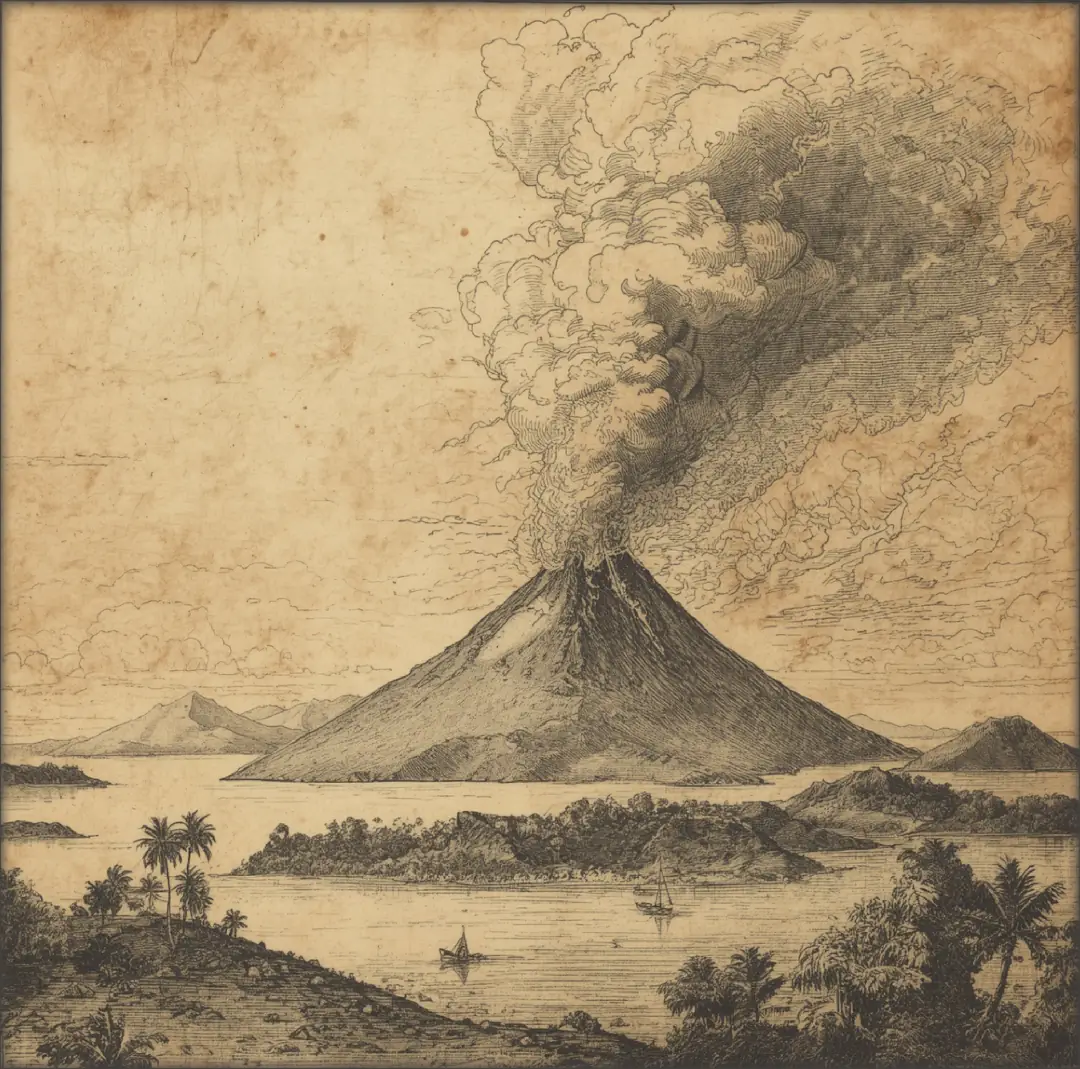
The Long Island Eruption of 1662
There is only one fixed date for the ‘founding generations’—the time of darkness, yuu kuia, in 1662 when ashfall from the eruption of the Long Island volcano off the coast of Madang covered the highlands in a blanket of ash.
Why more factual histories began to be passed on in men’s houses around the seventh generation or 1700s is unknown. This might be attributed to the impact of the sweet potato that arrived some 350-400 years ago on local trade routes from the coast, setting off migrations and complex developments that Engan forefathers felt should be documented. Some of these developments are summarized in Chapter 2 that gives an overview of development in Enga over the last 350-400 years.
Were Histories Rewritten?
Consistency Across Clans
This does not appear to be the case, because narratives of a single historical event collected in different clans of a tribe or across tribes rarely contradict one another on major points. Rather forefathers retained the entire collection of their historical narratives, so that chapters of history legitimating current interests could be opened strategically, leaving other chapters to be called on when conditions changed.
We developed a system to roughly date or sequence events such as wars, migrations, or the spread of rituals by generation. Before Generation 5, events can only be sequenced. After Generation 5 they can be roughly dated relative to some known events.
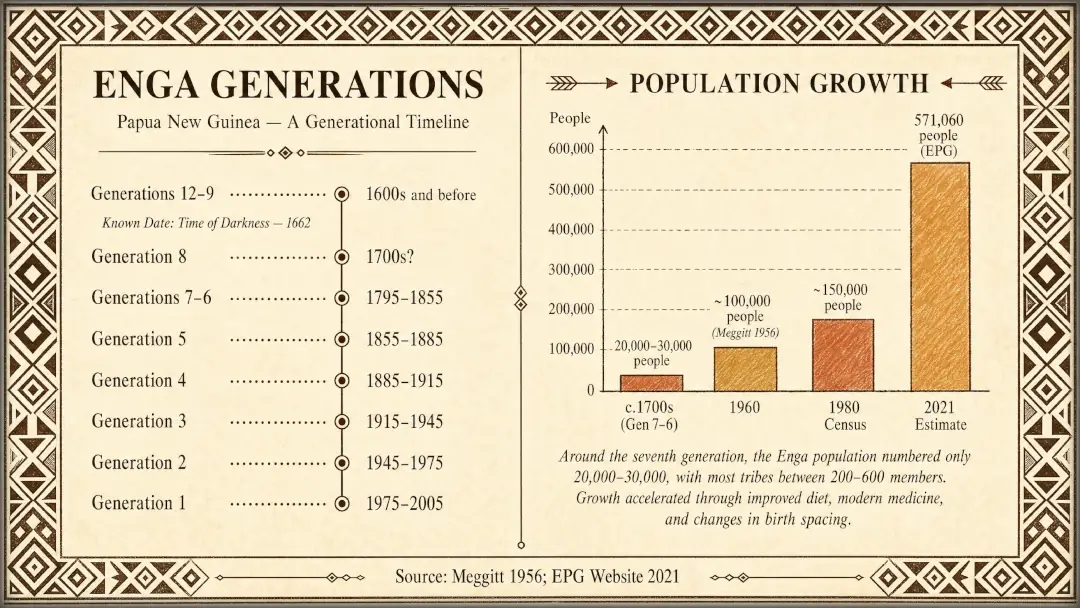
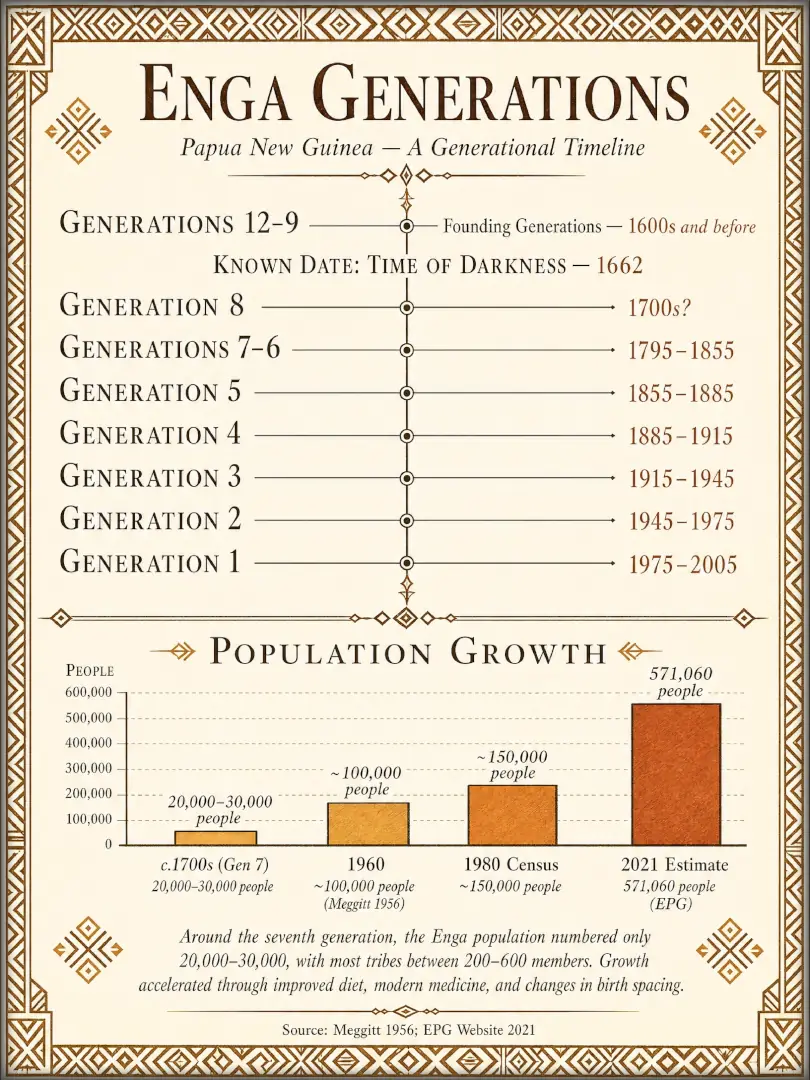
Sequencing Events by Generation
“An important consideration when imagining life in the past is recognizing that the population was very sparse then.”
— POLLY WIESSNER
an ongoing project
If you know your tribe’s history,
help us record it correctly.
The information presented here was collected by the Enga Take Anda team and many other educated Engans during the 1980s. It makes no claim to be complete or entirely accurate, as there are many version of the origin traditions. Feedback is welcomed.
Because this material lives on a website that can be edited, Engans who are knowledgeable about their own tribal histories can offer corrections and additions through the Enga Take Anda.